
Military EMS Personnel
How the Compact supports veterans, active-duty service members, the National Guard and Reserves, and their spouses.
The United States EMS Compact provides specialized support for veterans, active-duty military personnel, National Guard and Reserve members, and their spouses. All participating states have enacted legislation requiring expedited EMS licensure processing for qualified military-affiliated individuals.
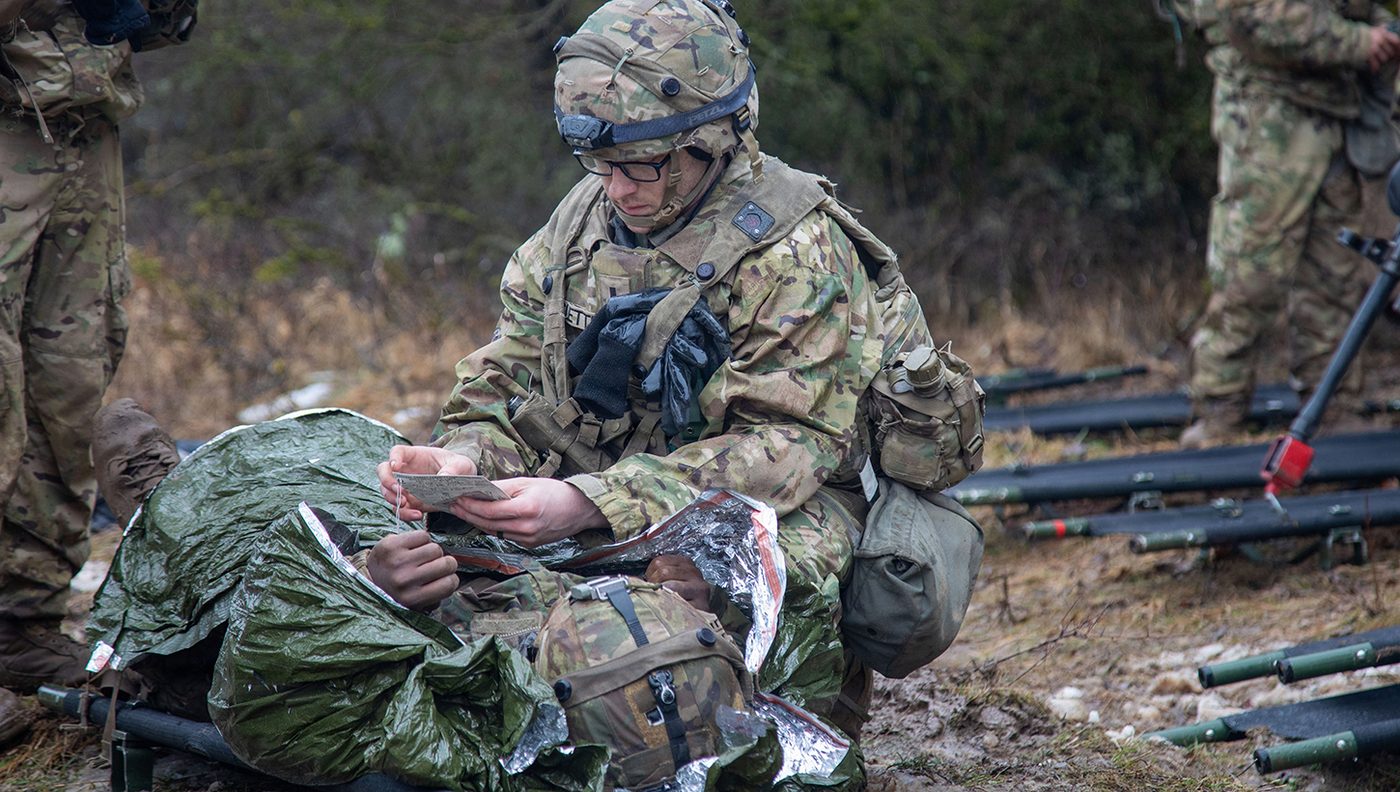
This commitment recognizes the contributions of military service members to emergency response, while ensuring that their medical training and credentials are recognized promptly when relocating or transitioning between duty stations or civilian employment.
The Servicemembers Civil Relief Act (SCRA)
The Servicemembers Civil Relief Act (SCRA) supports professional license portability for service members and their spouses. The portability provision is codified at 50 U.S.C. § 4025a. It was first added in January 2023 by the Veterans Auto and Education Improvement Act of 2022 (Pub. L. 117-333), then rewritten effective December 23, 2024 by the Servicemember Quality of Life Improvement and National Defense Authorization Act for Fiscal Year 2025 (Pub. L. 118-159). The current version requires a destination state to recognize a covered professional license held in good standing from another state when a service member or spouse relocates under official military orders.
Under the current law, a covered license is considered valid for its scope of practice in the new state when three conditions are met: the applicant holds a covered license in good standing, the applicant relocated to another state because of military orders, and the applicant submits an application to the new state's licensing authority. That application includes proof of military orders, a marriage certificate if the applicant is a spouse, and a notarized affidavit. The destination state may run a background check and may issue a temporary license while it processes the application.
The December 2024 amendment made several changes from the original 2023 version. It removed the prior requirement that the license have been actively used during the preceding two years, and it removed the earlier exclusion for licenses to practice law, so all professional licenses and certificates are now eligible.
How the SCRA and the EMS Compact fit together:
- The SCRA defers to interstate compacts. Under 50 U.S.C. § 4025a(e), a service member or spouse who holds a covered license to operate in multiple states through an interstate compact is subject to the requirements of that compact, and the SCRA portability section does not apply to them.
- For EMS clinicians, that means when both the home state and the destination state participate in the EMS Compact, the Compact governs: shared standards, real-time verification through the coordinated database, and coordinated discipline and enforcement among states.
- The SCRA's recognition requirement is the path that applies when the EMS Compact does not, for example when the destination state is not a participating state. In that case the new state must recognize the covered license, but there is no shared data system or coordinated enforcement behind that recognition.
In short, both mechanisms protect military families from being penalized for frequent relocations. The Compact provides a cooperative, state-led structure with built-in verification and accountability; the SCRA provides a federal backstop for moves the Compact does not cover.
For more information, see the Department of Justice's Servicemembers and Veterans Initiative and its December 2025 notification letter explaining the updated law to state licensing authorities. The Department of War maintains a list of occupational licensure compacts through its Defense-State Liaison Office. A service member or spouse who believes a licensing authority has not complied with the law may report it to the Civil Rights Division.
Who Is Eligible
The REPLICA legislation (Section 7) applies to:
- Veterans
- Active-duty service members
- Members of the National Guard and Reserves
- Individuals separating from an active-duty tour
- Spouses of the above
See the REPLICA Model Legislation, Section 7, for the full legal text.
Requirements for Expedited Licensure
To request expedited processing, eligible individuals must hold a current, valid, and unrestricted National Registry of EMTs (NREMT) certification at or above the level of the state license they are seeking. This satisfies the Compact's minimum education and examination requirements for EMS licensure.
- Participating states consider veterans, active-duty service members, Guard and Reserve personnel, and their spouses who hold a current unrestricted NREMT certification at or above the level of the requested state license as meeting the minimum training and examination requirements.
- Participating states expedite the processing of applications from veterans, service members, Guard and Reserve personnel separating from active duty, and their spouses.
- Individuals practicing under this section remain subject to the Adverse Actions provisions of Section 8 of the REPLICA model legislation.
Criminal History Checks and the Federal-Employee Exception
Initial licensure in a participating state requires an FBI-compliant, fingerprint-based criminal history check. The model legislation (Section 3) provides a narrow exception: federal employees, including military personnel, who have completed a suitability determination under 5 CFR § 731.202 may submit documentation of that determination in lieu of an additional fingerprint-based check, as provided in the Commission's rules.
This exception is not automatic. The state EMS office must verify that a federally adjudicated suitability determination has been completed and is properly documented. Most transitioning military medics, veterans, and federal EMS clinicians do not qualify for it and complete the standard fingerprint-based check.
A Note on Military Training and Civilian Licensure
The Compact supports mobility for qualified clinicians; it does not create an alternative licensure pathway for individuals who have not met nationally recognized standards. The term "medic" in a military context is broad, covering many roles, not all of which align with civilian EMS education standards. Clinicians who have completed a nationally accredited EMS program and hold a current National Registry certification are well positioned to obtain state licensure and use the Compact; those whose military training does not map to civilian standards may need additional accredited education before licensure. Where possible, completing accredited education, National Registry certification, and state licensure while still in uniform supports a seamless transition into civilian EMS.