
Governance
How the Interstate Commission is organized and led: its legal basis, officers, leadership, governing documents, and finances.
The Interstate Commission for EMS Personnel Practice is the multistate governmental body established by state law to administer and enforce the United States EMS Compact. The Commission oversees implementation among participating states, adopts rules, facilitates information sharing, and provides a forum to resolve interstate issues related to Compact operations. It is an instrumentality of the participating states and acts on their collective authority within the scope of the Compact.
The legal basis is REPLICA Section 10, which establishes the Commission as a joint public agency of the participating states and outlines its composition, voting, and meeting requirements.
Commissioner Appointments
Each participating state is represented by one voting delegate, the Commissioner, appointed by the Governor or the Governor's designee. In most states, the Commissioner is the senior executive-branch official responsible for EMS regulation, such as the State EMS Director, Branch Chief, or Bureau Chief. Where more than one state entity licenses EMS clinicians, the Governor designates which entity appoints the Commissioner. Each participating state holds one seat and one vote on matters before the Commission.
Commission Authority
The Commission's authority is limited to matters authorized by the Compact and related to interstate, cross-border practice. Core functions include:
- Representation and voting. One Commissioner per participating state, one vote per state.
- Rulemaking. Adoption of bylaws and promulgation of rules to administer cross-border practice under the Compact.
- Policies and procedures. Uniform policies to support consistent state implementation.
- Coordinated data. Governance of the National EMS Coordinated Database framework and related information-sharing rules.
- Enforcement and compliance support. Compliance monitoring, dispute resolution, and coordination among participating states to address interstate issues.
- Sovereign immunity and state authority. Operations consistent with each state's sovereign immunity and preservation of state control over the licenses it issues.
- Transparency. Public meetings and notice consistent with the Compact's open-meeting and rulemaking requirements.
Through shared governance, uniform rules, and real-time data sharing, the Commission enables qualified EMS clinicians to practice across state lines while preserving state sovereignty and protecting the public.
Leadership
Day-to-day operations are managed by the Executive Director in collaboration with the Executive Committee, which is elected by the Commissioners and is responsible for administrative oversight between regular Commission meetings.
The current Executive Committee:
- Commissioner Kraig Kinney (Indiana), Chair
- Commissioner Wayne Denny (Idaho), Vice Chair
- Commissioner Mark Herrera (Utah), Secretary
- Commissioner Brad Vande Lune (Iowa), Treasurer
- Commissioner Michael Johnson (Georgia), Member-at-Large
- Commissioner Joe Schmider (Texas), Immediate Past Chair (non-voting)
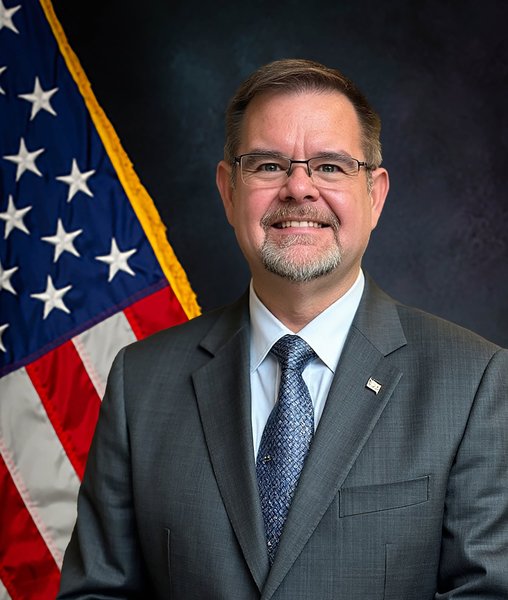
Donnie Woodyard, Jr., MAML, NRP
Executive Director
Donnie Woodyard, Jr. serves as the Executive Director of the United States EMS Compact, bringing more than three decades of leadership experience in EMS operations, regulation, and system design. His career spans state, national, and international roles, reflecting a lifelong commitment to advancing the EMS profession through policy innovation and intergovernmental collaboration.
Donnie has served as State EMS Director in two states and as Chief Operating Officer of the National Registry of EMTs, leading major initiatives in national EMS standards and technology. As one of the architects of the EMS Compact's operationalization, he represented Colorado as a Commissioner, later serving as Vice Chair and Chair of the Executive Committee.
His decade of international EMS development includes establishing sustainable emergency care and trauma systems in post-disaster and conflict regions. A graduate of the Naval Postgraduate School's Executive Leaders Program and holder of a Master of Arts in Management and Leadership, Donnie is currently pursuing dual doctoral degrees: a Doctorate in Law and Policy focused on the role of interstate compacts in national security, and a Doctor of Healthcare Administration. He also holds a Certificate in Artificial Intelligence in Healthcare from Harvard Medical School.
With a career rooted in both field EMS experience and administrative excellence, Donnie continues to shape national EMS policy with a vision grounded in clinician empowerment, professional accountability, and public safety.
Compact Counsel
Legal counsel to the Commission is provided on a pro bono basis by Page, Wolfberg & Wirth, LLC, a national EMS law firm.

Doug Wolfberg, JD
Compact Counsel
Doug Wolfberg, JD is a founding partner of Page, Wolfberg & Wirth (PWW), widely recognized as the nation's leading EMS law firm. He has dedicated more than four decades to the advancement of EMS law, policy, and education, and has been an active EMS clinician, educator, and advocate since 1978.
Doug's career includes service as a county and regional EMS director, work at the U.S. Department of Health and Human Services on federal EMS and trauma policy, and legal practice as a healthcare attorney before co-founding PWW in 2000. He is admitted to the bar in Pennsylvania and New York, and to practice before the U.S. Supreme Court. In addition to his legal practice, Doug teaches EMS law at the University of Pittsburgh and health law at Widener University School of Law, where he also serves on the Board of Overseers.
He is a prolific author and speaker, known for his engaging presentations and deep expertise in EMS regulation, compliance, and governance. Doug serves as legal counsel to the United States EMS Compact, providing guidance on administrative, regulatory, and statutory matters.

Christie M. Mellott, JD
Compact Counsel
Christie Mellott, JD is Of Counsel with Page, Wolfberg & Wirth and serves as Compact Counsel specializing in Medicare enrollment, administrative law, and healthcare compliance. She joined PWW shortly after its founding in 2000 and advises EMS agencies nationwide on operational, legal, and employment issues.
Before entering law, Christie worked in healthcare for a decade, including in clinical and administrative roles. During law school, she served as assistant editor of the Environmental Law and Technology Journal and interned for Pennsylvania's Office of General Counsel. She has since served in legal roles with the Pennsylvania Department of Environmental Protection and private healthcare law firms.
Christie frequently presents at national and state EMS conferences and is a contributing author to numerous EMS and public safety publications. Her expertise in regulatory compliance and provider enrollment supports the Compact's legal framework and assists participating states in navigating administrative procedures.
For a full record of past Executive Committee officers and their service dates since 2017, see the Executive Committee Service History.
Commission Staff
The Commission is grateful to the professional staff who have led its day-to-day work since its earliest years. The position began as the Compact Educator and became the Executive Director.
| Name | Role | Service dates |
|---|---|---|
| Donnie Woodyard, Jr. | Executive Director | July 1, 2023 to present |
| Ray Mollers | Executive Director | March 1, 2021 to July 1, 2023 |
| Dan Manz | Compact Educator | December 17, 2019 to March 1, 2021 |
| Sue Prentiss | Compact Educator | 2016 to December 17, 2019 |
Sue Prentiss was the Commission's first staff member, serving as Compact Educator. Dan Manz was the last to hold that role, and Ray Mollers was the first to serve as Executive Director.
Governing Documents
The Commission operates under a layered framework of governing documents, each available in full on the Commission's site:
- REPLICA model legislation. The uniform law enacted by each participating state that authorizes the Compact and establishes the Commission. See How States Join for the bill and background.
- Bylaws. Adopted October 17, 2017, and amended June 13, 2023, and November 15, 2023. The bylaws govern the Commission's management and operations, including the officer structure (Chair, Vice Chair, Secretary, Treasurer, each serving two-year terms), membership, meetings, quorum and voting, committees, and finance. The bylaws remain subject to and limited by the Compact.
- Administrative rules. Binding rules adopted by the Commission through a public rulemaking process to administer cross-border practice, including the Coordinated Database rules.
- Policies. Uniform Commission policies that support consistent state implementation.
The official text of each governing document is published by the Commission. For the full bylaws, rules, and policies, contact the Commission.
Budget and Finance
The Commission adheres to public-sector standards of financial transparency, accountability, and fiscal restraint. Its fiscal year runs from July 1 to June 30.
REPLICA Section 10 authorizes the Commission to secure and manage the funding necessary to carry out its duties, including accepting grants, donations, and other lawful revenue, and, if necessary, levying annual assessments on participating states or reasonable fees on other parties. The Commission may not incur obligations without first securing adequate funds, nor pledge the credit of any participating state without that state's express authorization.
In practice, the Commission is funded through a stable, multi-year grant from the National Registry of EMTs. It has never imposed any state assessments or fees, and no fees have ever been imposed on individual EMS clinicians. The Privilege to Practice is provided at no cost to clinicians, and the Commission's services are provided at no cost to participating states.
The Commission upholds financial transparency through Treasurer's reports presented at each Executive Committee and Commission meeting, budget discussions and approvals in open session, and an independent audit or financial review at least once a year, following standard governmental auditing practices.
For a fuller account of the Commission's funding authority, funding source, and fiscal transparency practices, see the Budget-Finance Committee.
This page is for informational purposes and does not constitute legal advice.